Tuesday, February 9, 2010

All for the love of wearing kimono


Thursday, Dec. 31, 2009

All for the love of wearing kimono
Young and old have been gathering in Ginza for years to promenade in their favorite garb

By SAYO SASAKI
Kyodo News

On a sunny Saturday afternoon in mid-December, several dozen people in Christmas-themed kimono appeared in Tokyo's bustling Ginza district.

News photo:
Fashion passion: Women take part Dec. 12 in "Kimono de Ginza," a monthly event to wear the traditional costume on the streets of Tokyo's bustling Ginza district. KYODO PHOTO

People watched them pass, clad in traditional belted robes of differing patterns and flower motifs, standing out in the otherwise monotone crowd.

As the clock struck 3 p.m., they started moving down a pedestrian street in loose groups, heading off to shops in the area, while the curious followed to take snapshots and others asked if this was part of a film shoot. One woman smiled and shook her head.

The sight has become common in the area as "Kimono de Ginza," a monthly occasion to wear kimono, marks its 10th anniversary in 2010.

The event is open to anyone who shows up at the specified time and place on the second Saturday of every month. Participants can exchange information on kimono and can leave anytime to go off on their own, but all are invited to a dinner at the end of the day.

Over the years, what started as a gathering of less than a dozen male friends has grown into a more public event, drawing an average of about 50 men and women ranging in age from their 20s to their 80s. On some days, more than 100 people have turned up.

"The only rule we have is this — do not criticize others for how they are dressed," said a man who goes by the name Gojyaku Kyoya, stating the rule that some say is the key to why the event has lasted so long and unites people who like formal kimono and those who like casual kimono.

The 59-year-old longtime participant said he was looking for a place to wear kimono "more casually" and ended up at Kimono de Ginza, disliking the strict dress codes imposed at some gatherings.

For many decades kimono were worn with a serious face — considered appropriate for special occasions such as graduations, coming of age ceremonies and weddings. But over the past few years, they have been gaining popularity as casual wear.

Popular Japanese social networking Web sites like mixi and GREE list more than 700 Internet communities on kimono, with a number of them holding gatherings in the real world. Meanwhile, inexpensive secondhand kimono shops are sprouting up everywhere.

Writer-illustrator Ima Kikuchi, who has published several books on kimono, said the trend picked up sometime around 2002 and the number of kimono lovers has since steadily grown.

"A nonceremonial style of kimono has established itself as a new genre today, and people are enjoying it, just like Western clothes," she said, explaining the increase in kimono shops and availability of colorful socks and decorative collars for kimono that attract younger generations.

She also noted the different desires of people who wear kimono, saying, "I think there are people who wish to transform themselves by wearing kimono and those who just want to be themselves."

She added that women in their 30s and 40s are leading the kimono trend, while older generations tend to go for wearing kimono they got from their parents.

While past Kimono de Ginza events have had many young participants, including university students and people in their 20s, there were many more people in their 40s and 50s whose parents frequently wore kimono but who themselves grew up not wearing them.

"My mother loved kimono, but for a long time I could not understand why she loved them so much. I wanted to find out," a 50-year-old woman from Yokohama said in explaining why she started wearing kimono and coming to the event.

"Here I met with people who wear kimono like they wear T-shirts. It was an eye-opener," she said. "This event taught me that a kimono is something to play with, not something to admire."

Handcrafting and mixing different materials is part of the fun. The Yokohama woman wore a yellow ribbon used for wrapping a bottle of wine instead of a thin strap used in keeping the "obi" (sash) in position. Others had sewn a Christmas-themed cloth together and made it into an obi or painted a snowman on a kimono jacket to suit the season.

"You don't have to pay millions to enjoy kimono," said Kyoya, pointing out another female participant, who jokingly said the total amount she paid for her full ensemble, including sandals, was "cheaper than buying clothes at Uniqlo."

Another participant, Sheila Cliffe, who teaches English at Jumonji University in Saitama Prefecture, gave an artistic reason to love kimono.

"A kimono has poetry. It has many different motifs, like flowers, vegetables and even bugs that you won't see on Western clothes, and by wearing it you can create a story, like Christmas," she said in Japanese, showing her kimono coordinated in Christmas red, green and gold.

There have been several non-Japanese participants and others who did not know how to wear kimono.

Many participants said this is not a concern because others can teach them how to wear kimono, show them how to coordinate different colors and items, and provide information on where to get them.

"Anyone is welcome here," said Shigematsu, one of the earliest participants in the event. "I just think it is nice that we can all enjoy wearing kimono as friends."

Regardless of age or background, the participants appear to have built a strong bond by the time they come together for the dinner and drinks portion of the event.


http://search.japantimes.co.jp/cgi-bin/nn20091231f1.html

Monday, December 1, 2008

Maiko sing Gion theme in Maruyama Park

Gion Kouta Festival

Miyagawacho maiko Toshiteru-san (16) and Toshimari-san (17) present flowers and sing.

Mikihiko Nagata (1887-1964) is credited with writing the lyrics of "Gion Kouta", the Balad of Gion.

The popular tune explores the seasons in Kyoto, and maiko ozashiki still perform the song, a staple at ozashiki banquets.

Thursday, November 27, 2008

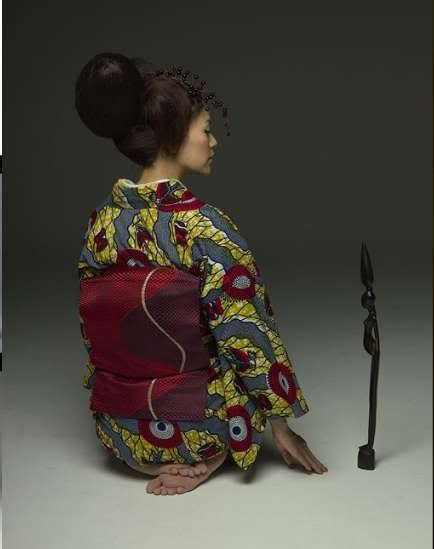
WA-frica


Wa (Japanese) + Africa = Wafrica.

Tendhunter's Gallery - Cross-Cultural Couture - Wafrica Kimono


Wafrica is a unique cross-cultural clothing line is comprised of traditional Japanese kimonos made from African fabrics. It's the brainchild of well-traveled, Nissan car designer, Serge Mouange (born in Cameroon, raised in Paris and now lives in Tokyo)

While the Wafrica kimonos retain every bit of their Japanese sensibilities, the bright traditional African patterns lend them a vibrance and energy that makes these stoic models come alive.

wafrica.jp - But beware! It's unlinkable, music-in-background, browser-crashing Flashs-trosity.

From Trendhunter

Monday, October 27, 2008

Maiko in Vogue

Vogue’s ‘Stranger in a Strange Land' Spread


The October 2008 issue of Vogue Nippon featured a very captivating editorial that fashionably showcases what it feels like to be a ‘Stranger in a Strange Land.’

Styled by Anastasia Barbieri in true haute couture that is worthy of a Vogue editorial, model Carmen Kass is captured by talented photographer Yelena Yemchuk as a European or American in Japan.

In addition to the exquisite couture fashion, the art direction of the shoot adds a subtle yet deep dimension that transcends an otherwise typical fashion shoot into a captivating story.


The 'maiko' are just girls dressed up in kimono, but it's done very, very well. I doubt they could have afforded real maiko to stand by for hours (sometimes days) for a photoshoot if they weren't the main subject.

Friday, May 30, 2008

Komomo: A Geisha's Journey ~ Book Tour


A Japanese geisha has been teaching New York about the ancient art of her profession. Komomo, which means Little Peach, danced, sang and signed copies of her book titled "A Geisha's Journey" for curious onlookers in an art gallery and book store.

Part 2 of that segment here:
http://video.msn.com/video.aspx?mkt=en-gb&vid=d3834244-70d8-48a8-b175-4d7df465d6ec&fg=rss&from=en-gb

Komomo's story has spawned some more questions among Westerners:
http://www.citizensugar.com/1573126

Saturday, May 24, 2008

Daily Yomiuri: Kyoto Kagai Photo Book

Kyoto's entertainment districts captured in photo book
Hiroko Ihara, Daily Yomiuri Staff Writer
http://www.yomiuri.co.jp/dy/features/culture/20080522TDY16003.htm

KYOTO--A recently published photographic guide to five Kyoto entertainment districts has been widely praised, both for the succinct introduction it offers newcomers to the city's traditions and culture and the spotlight it places on the area's retention of long-standing Japanese customs.

"Kyoto, an Ancient Capital of Traditional Culture and Musical Art," which features 81 pages of widely varied color photographs accompanied by English text, is the first book of its kind, according to its publisher, the Kyoto Traditional Musical Art Foundation (nicknamed Okini Zaidan).

"We've been told it's very helpful, because there was no material like this [about Kyoto's entertainment districts]. The photos provide a brilliant visual guide for the foreign audience," said Osamu Ito, the secretary of Okini Zaidan.

About 10,000 copies have been given free of charge to people and organizations involved with introducing Japanese culture to the international community, such as tour guides, researchers, universities and international exchange groups.

The about 200 photographs featured in the book were taken by Hiroshi Mizobuchi, a photographer based in Uji, Kyoto Prefecture. Having shot Kyoto's entertainment districts for the past 35 years and published more than 10 collections on the theme, Mizobuchi has a deep understanding of the area.

His work in the Kyoto guide casts light on every aspect of life in the entertainment districts, called "hanamachi" or "kagai," but it pays particular attention to geiko, entertainers who have mastered their techniques, and apprentices to the trade, who are known as maiko.

A number of annual events are featured, starting with the Shigyoshiki New Year ceremony, which sees the geiko and maiko appear wearing hair ornaments made of rice plants and formal black kimono with patterns on the bottom.

Kyoto's natural scenery, famously distinct from season to season, is beautifully captured in pictures of dance performances by geiko and maiko at different times of year. Their contribution to the festive atmosphere at annual events like the Gion Festival in July and the Kaomise all-star-cast kabuki performance in December is delightfully evident.

Elsewhere, Mizobuchi's pictures show the geiko and maiko performing for customers at ochaya teahouses, their day-to-day workplace.

Other sections of the book go behind the scenes: Brief pictorial essays reveal how to put on a kimono, apply makeup and do hair in the style of geiko and maiko.

Mizobuchi said: "Their culture and lifestyle used to be part of the Japanese way of life. They're separated a bit from ordinary Japanese these days, but they're still active in these districts."

He recalls a time, several years after he first began photographing maiko and geiko, when trade in the districts was declining. The proprietor of an ochaya in the Gion Kobu entertainment district told him: "The number of maiko in my district is down to 10. You're taking our photos at the right time--we might become extinct."

The comment spurred Mizobuchi to expand his focus to include the entire district, taking in its landscape and events as well as its people.

Fortunately, the districts' fortunes revived, and there are now about 100 maiko working in Kyoto. "Their training consists of Japanese dance, learning about the tea ceremony, flower arrangement, and playing musical instruments. It's very severe. Those who come from outside Kyoto also need to acquire an elegant Kyoto accent," Mizobuchi said, noting that only one out of 10 trainees actually go on to become maiko.

"But those who hang on are extremely lively and dedicated. It's a special thing," he said.


Here's the thing: the foundation is making the book available to Daily Yomiuri readers free of charge. Hiroshi Mizubushi 溝縁ひろし is the unofficial official geisha photographer in Kyoto (his books are sold at the district odori).

Monday, January 7, 2008

Sayuki of Asakusa

Tokyomango: http://www.tokyomango.com/tokyo_mango/2007/12/first-white-gei.html
Japantoday: http://www.japantoday.com/jp/news/423498
Telegraph UK: http://www.telegraph.co.uk/news/main.jhtml?xml=/news/2008/01/07/wgeisha107.xml
and debito's blog: http://www.debito.org/index.php/?p=876

Japan’s first ever foreign geisha
Courtesy of Sayuki

For the first time in the 400 year history of the geisha, a Westerner has been accepted, and on December 19, will formally debut under the name Sayuki.

Sayuki is specialized in social anthropology, a subject which requires anthropologists to actually experience the subject they are studying by participating in the society themselves.

Sayuki has been doing anthropological fieldwork in Asakusa - one of the oldest of Tokyo’s six remaining geisha districts - for the past year, living in a geisha house (okiya), and participating in banquets as a trainee. She has been training in several arts, and will specialize in yokobue (Japanese flute).

Sayuki took an MBA at Oxford before turning to social anthropology, and specializing in Japanese culture. She has spent half of her life in Japan, graduating from Japanese high school, and then graduated from Japan’s oldest university, Keio. Sayuki has lectured at a number of universities around the world, and has published several books on Japanese culture. She is also an anthropological film director with credits on NHK, BBC, National Geographic Channel programmes.

http://www.sayuki.net


But oh wait, even after sending out her press release to debito, and giving interviews about being "inducted into the mysteries of geisha," she wants you to forget her real name and hope you can't google her using the clues she's already provided.


SAYUKI has said:

(It has been a very long road to becoming a geisha, and has taken several years of preparation, an enormous investment, and considerable perseverance. Whatever you are imagining geisha life is like, it is a great deal harder than you know.)

I had made a decision to keep my life as an academic and my life as a geisha as separate as possible. Confusing the two could have very unwelcome implications for my my fieldwork now, particularly when I have struggled so hard to begin. I would be very grateful if those people speculating about my identity could please not do so and remove the posts.


This is purely anthro conjecture, from one card-carrying anthropologist to another, but...
To get a BA in anthro (in the States at least) you have to take at least one ethnographic methodology course, and that usually means conducting some kind of participant-observation study. Now clearly you've already written books on your first-hand research into Japanese insurance corporations.

One of the pitfalls of participatory research is not being able to separate your various selves - academic, political, familial, real-life, what have you - from the work. It's sucks, but you can't always hole yourself up in your tent and make notes in some optimal Boasian environment. Gay and lesbian researchers don't lie about their sexual orientation when the issue comes into play. Feminist researchers can't mask or hide their political viewpoints. Non-native 'outsider' anthropologists usually have to acknowledge that they just don't look like the population they're supposed to be studying. It will all come out in the work anyway, so what's the big deal about full disclosure? Is it going to compromise an already compromised identity?

Maybe anthro in the UK is just done differently, but what you ARE is hard to separate from what you are DOING. Is it a question of motivation? I can understand if you want to become a geisha because you genuinely want to become a geisha. Cool. I can understand if you want to become a geisha so you can write a book. That's fine too.

The public doesn't have to speculate. The 'secret' identity is already out, published by legitimate news sources no less. As far as I'm concerned, she opened the door on identity.

Discussion, speculation, critique - these are all sorts of 'mean' things anthropologists do to one another in their circles. If you put up a good defense in getting your doctorate, the greater public will be a cakewalk.